
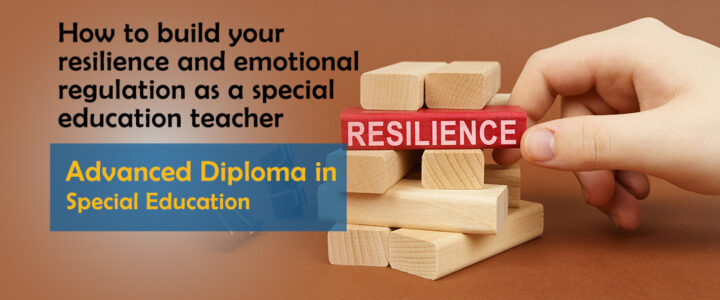
Special education teachers carry a unique emotional load. They support learners with diverse needs, collaborate with families navigating uncertainty, and manage classrooms where progress is often nonlinear. The work is meaningful, but it can also be emotionally demanding. Building resilience and emotional regulation isn’t just a professional skill—it’s a form of self-preservation that allows teachers to stay grounded, compassionate, and effective over the long term.
Emotional regulation is often misunderstood as a personality trait, but in reality, it is a skill that can be developed. It begins with awareness: noticing your emotional triggers, understanding how your body responds to stress, and learning to pause before reacting. For special educators, this might mean recognising when frustration rises during a challenging behaviour episode or when fatigue makes you more sensitive to noise or conflict. This awareness becomes the foundation for resilience, because you cannot regulate what you do not first acknowledge.
Reframe challenges through a compassionate lens
Special education is filled with moments that test patience—meltdowns, communication barriers, slow progress, or unexpected setbacks. Instead of interpreting these moments as personal failures or deliberate resistance, resilient teachers learn to see them as signs of a student’s struggle rather than a challenge to their authority. Shifting from “This student is giving me a hard time” to “This student is having a hard time” reduces emotional strain and keeps you connected to the purpose behind your work.
Resilience grows in community
Special education teachers benefit immensely from having colleagues who understand the daily challenges, mentors who offer perspective, and allied professionals who share insights. Talking through difficult days reduces emotional pressure and reminds you that your experiences are valid and shared. No teacher is meant to carry the emotional weight of this work alone.
Strengthening your professional toolkit
Confidence reduces stress, and the more strategies you have, the calmer you feel when challenges arise. This includes behaviour support techniques, communication strategies for nonverbal learners, trauma‑informed practices, de‑escalation skills, and a strong understanding of sensory needs. When you feel equipped, you feel more grounded—and resilience naturally increases.
Self‑compassion plays a crucial role
Special educators often hold themselves to impossibly high standards, but perfectionism drains resilience. Practicing self‑compassion means allowing yourself to be human, accepting that some days will be harder than others, and speaking to yourself with the same patience you offer your students. A self‑compassionate teacher is a sustainable teacher.
Special education teachers do extraordinary work, and to sustain that work, they must care for themselves with the same patience, compassion, and intentionality they offer their students. By nurturing self-awareness, boundaries, supportive relationships, professional confidence, emotional regulation skills, and self-compassion, special educators not only protect their well-being—they also create classrooms where students feel safe, understood, and supported.
Critically, understanding the diverse profiles of learners can strengthen teacher confidence and resilience. When educators understand the characteristics, learning needs, and behaviours associated with different categories of exceptional children, they are often better equipped to respond with patience and appropriate strategies rather than frustration or uncertainty. This knowledge aids in interpreting behaviours more accurately and allows for more effective plans for intervention.
College of Allied Educators offers our Diploma in Education (Special Needs), that provides an essential introduction to the various categories of exceptional children and educational programmes available. The course will also train you to confidently design and implement an Individualised Education Plan or IEP to aid in specific areas such as language and communications.
This is a 6-month, part-time programme that will allow you to continue onto the Advanced Diploma in Special Education, a 12-month course that trains educators and parents with the knowledge and skills to identify, and support children with diverse learning and developmental needs and the basic principles and practices of effective teaching and learning.
For a FREE COURSE PREVIEW
CALL US at 6533-0031
EMAIL your enquiry to ENQUIRY@ICAE.EDU.SG
or Register for your free preview below: